New European Policy Brief Calls for Stronger Air Quality Standards to Protect Public Health


ExpoHealthNet brings together scientific evidence from seven European research projects and presents recommendations to address the health risks of ultrafine particles and combined environmental exposures.
Air pollution remains one of Europe’s most significant environmental health risks. A new policy brief published by the European research cluster ExpoHealthNet highlights major gaps in current EU air quality legislation and calls for stronger protection against ultrafine particles (UFPs) and the combined effects of environmental pollution.
Entitled “Closing the Ultrafine Particle Gap in EU Air Quality Law”, the publication brings together scientific evidence from seven Horizon Europe-funded research projects. It provides policymakers with concrete, evidence-based options for strengthening the EU Ambient Air Quality Directive (Directive (EU) 2024/2881).
Ultrafine Particles: A Significant But Insufficiently Regulated Health Risk
Ultrafine particles are extremely small airborne particles, measuring less than 100 nanometres in diameter. They are primarily generated by combustion processes, including road traffic, industrial activities and energy production.
Due to their small size, these particles can penetrate deep into the respiratory system and contribute to biological processes associated with cardiovascular and other chronic diseases.
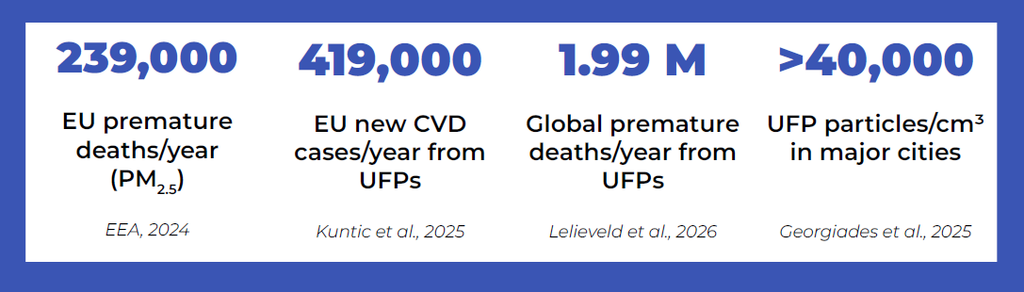
Scientific evidence presented in the ExpoHealthNet policy brief highlights the scale of the potential health burden:
- An estimated 419,000 new cardiovascular disease cases annually in the European Union are attributable to ultrafine particle exposure.
- Worldwide, approximately 1.99 million premature deaths per year are estimated to be associated with ultrafine particle pollution.
- In Europe, the estimated annual mortality burden amounts to 35.7 deaths per 100,000 inhabitants.
- Ultrafine particle concentrations can exceed 40,000 particles per cubic centimetre in major urban areas.
These estimates demonstrate the importance of addressing ultrafine particle exposure as part of European public health and environmental policy.
Despite growing scientific evidence, ultrafine particles are not yet subject to binding ambient air quality limit values in the European Union.
The revised EU Ambient Air Quality Directive introduces mandatory monitoring at designated monitoring supersites. However, specific concentration limits and exposure reduction obligations for ultrafine particles are still missing.
Four Priorities for Future European Air Quality Policy
The ExpoHealthNet policy brief identifies four priority areas for improving the protection of public health.
- Establish regulatory standards for ultrafine particles
The brief recommends developing a harmonised framework for measuring and assessing ultrafine particle exposure, with the aim of introducing appropriate air quality standards and binding limit values. - Move towards WHO air quality recommendations
The EU’s annual PM2.5 limit value for 2030 is set at 10 μg/m³, twice the World Health Organization’s recommended guideline of 5 μg/m³. ExpoHealthNet proposes a legally defined pathway towards closer alignment with WHO recommendations. - Consider the combined effects of environmental exposures
People are exposed to multiple environmental stressors simultaneously, including particulate matter, nitrogen dioxide, traffic noise and chemical pollutants. Current regulatory approaches largely assess these factors individually.
The policy brief proposes exploring a Cumulative Exposure Index to better reflect the health risks associated with combined environmental exposures. - Strengthen the scientific basis for regulatory decisions
Innovative approaches, including molecular biomarkers, mechanistic research, advanced exposure modelling and next-generation risk assessment methods, can complement epidemiological evidence and support future regulatory decisions.
The policy brief presents different levels of ambition for each policy option, allowing decision-makers to consider practical measures within the existing EU legal framework.
Turning Scientific Knowledge into Policy Action
The policy brief was developed by Working Group 1 – Science for Policy and Practice of ExpoHealthNet, with contributions from all seven participating research consortia.
By combining expertise in environmental exposure assessment, epidemiology, toxicology, molecular biology, computational modelling and public health, the cluster aims to strengthen the connection between scientific research and European policymaking.
The publication represents an important step in translating complex scientific findings into practical recommendations for environmental and health protection.
An Important Opportunity for European Action
The policy brief comes at a crucial stage in the implementation and future review of European air quality legislation.
EU Member States are required to transpose the revised Ambient Air Quality Directive into national law by December 2026. National air quality planning milestones follow in 2028, while the European Commission must review the scientific evidence underpinning EU air quality standards by the end of 2030, or earlier if substantial new scientific findings justify it.
ExpoHealthNet encourages policymakers to consider the latest scientific evidence during this process and to strengthen the role of health protection in future air quality decisions.
The message of the policy brief is clear: Effective air quality policies must reflect the full complexity of environmental exposures and their impacts on human health.
Policy Brief
Read the full policy brief on Zenodo.
About ExpoHealthNet
ExpoHealthNet is a European research cluster bringing together seven Horizon Europe-funded projects, including ExpoSignalz. More information.
Follow ExpoHealthNet on LinkedIn.